

The Silent Loss: Why Your "Safe" FD Is Quietly Making You Poorer
A 6.5% Fixed Deposit feels safe, but after 30% tax and 6% inflation, it’s quietly eroding your wealth. Discover the real math of FDs, how global economies built wealth by shifting to equities, and the Shariah-compliant alternatives to protect your financial future.
The Silent Loss: Why Your “Safe” FD Is Quietly Making You Poorer
By Mohammed Abdul Khuddus
Senior Investment,Wealth Advisory & Retirement Planning Consultant
Most investors believe they are playing it safe when they park their savings in a Fixed Deposit. The logic feels sound: the principal is protected, the interest rate is locked in, and the bank guarantees the return.
But here is the uncomfortable truth that the FD receipt doesn’t tell you.
For most investors, a 6.5% FD feels safe. But after paying 30% tax on the interest, the real return drops to under 4.6%. When actual inflation is running at 6–7%, you are not preserving wealth. You are losing ₹20,000 to ₹30,000 every single year on every ₹10 lakh you save.
That is not safety. That is a slow, silent erosion of your financial future.
The Math That Changes Everything
Let’s put real numbers to this, using current data from the Indian market. As of October 2026, the highest one-year FD rates from major private banks are around 6.25% to 7.25%, depending on the bank and tenure. For a typical investor in the 30% tax bracket, the post-tax return on a 6.5% FD is roughly 4.55%.
Now compare that to actual inflation. India’s Consumer Price Index (CPI) stood at 5.54% in September 2026. Food inflation was even higher, at 7.74%.
Here is what that means in practice:
Metric | Amount |
|---|---|
FD Amount | ₹10,00,000 |
FD Interest Rate | 6.5% |
Gross Interest Earned | ₹65,000 |
Tax (30% slab) | ₹19,500 |
Net Interest After Tax | ₹45,500 |
Effective Post-Tax Return | 4.55% |
Actual Inflation (CPI) | 5.54% |
Real Purchasing Power Change | -₹9,900 |
Even at a 6.5% FD, you are losing purchasing power. And if we use a more realistic inflation figure for a household with education, healthcare, and lifestyle costs—closer to 7%—the loss widens to nearly ₹25,000 per year on every ₹10 lakh.
A red portfolio for a few months makes people uncomfortable. But losing money slowly, invisibly, and permanently to taxes and inflation is the real risk that no one warns you about.
What Other Economies Did (And Why It Matters)
If the FD trap were unique to India, it might be easier to dismiss. But history shows that economies which shifted away from cash and fixed income toward productive assets did not just survive—they built lasting wealth.
Japan: From Cash Hoarders to Equity Investors
For decades, Japanese households were the world’s most conservative savers. But according to the Bank of Japan, the share of cash and deposits in household assets fell from 53.7% in late 2022 to 44.6% by mid-2026. Over the same period, equity holdings surged. When inflation finally became real, Japanese households adapted. They did not abandon safety—they redefined it.
The United States: Equity Exposure at Historic Highs
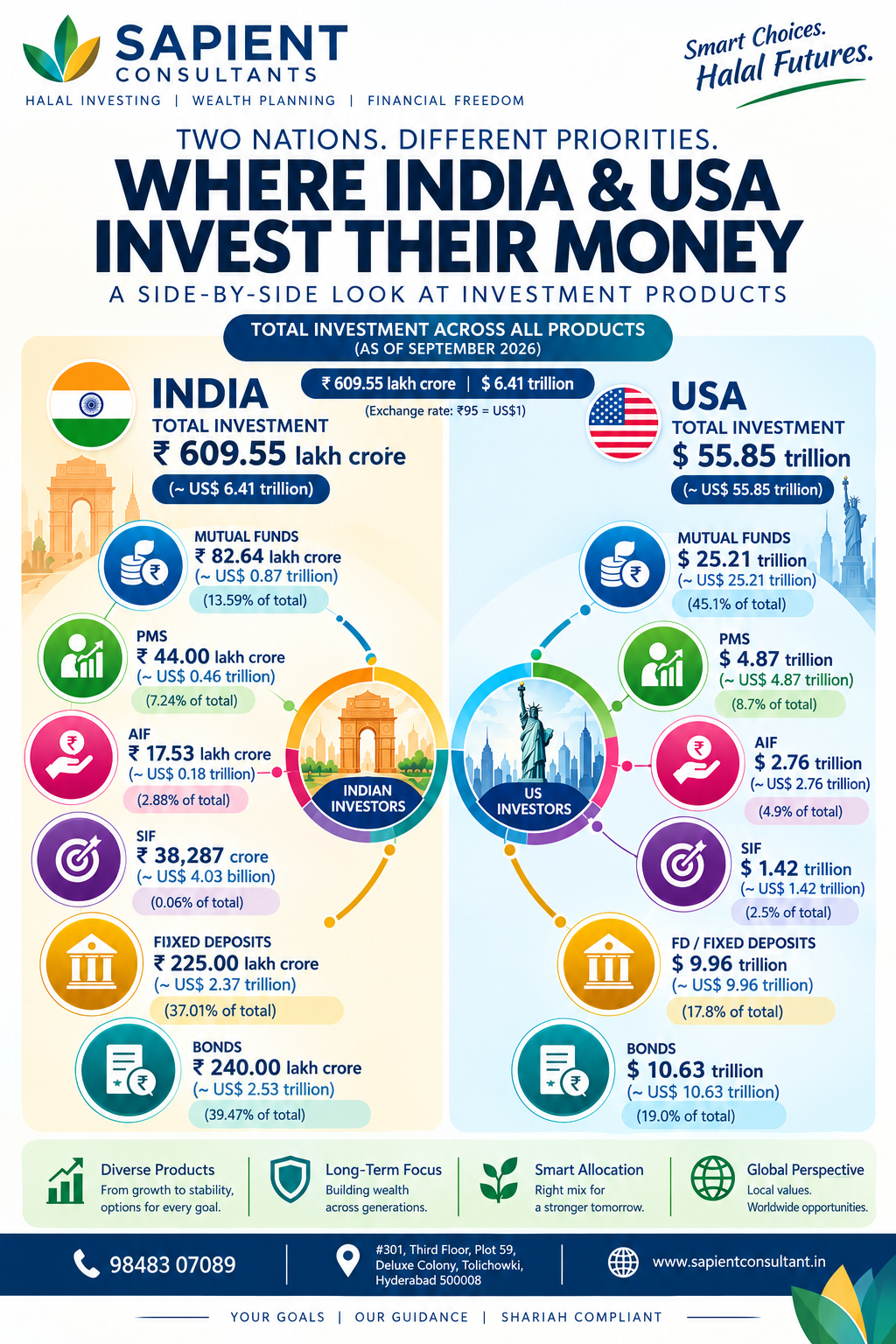
According to the American Association of Individual Investors (AAII), stocks reached 71.8% of the typical retail portfolio in September 2026—the highest share since 2017. US households have consistently favored equities over fixed income for decades, resulting in the largest pool of household wealth in history.
The United Kingdom: A Cautionary Tale
The UK offers a sobering counterexample. According to Fidelity International, UK households’ direct equity exposure fell from 23% in 1999 to just 17% by 2025, while cash holdings rose to 35%. Because they chose the comfort of cash over the discomfort of volatility, Fidelity estimates UK households have £414 billion less invested in markets today than they would have had otherwise.
The Turbulence Is Normal
If the past two years have taught investors anything, it is that equity markets are not a straight line. Corrections happen. Volatility is part of the deal.
But the data shows that missing the best days of the market is far more costly than enduring the worst.
Research from JPMorgan covering the S&P 500 from 2005 to 2024 found that staying fully invested turned $10,000 into $71,750 over 20 years. Missing just the 10 best days slashed that to $32,871. And here is the critical detail: seven of the market’s 10 best days occurred within just two weeks of the 10 worst days.
If you flee during crashes, you miss the rebound. The market’s turbulence is not a bug. It is the price of admission to long-term wealth creation.
The Real Risk Is Not Volatility
Every investor must answer a fundamental question: What is the greater risk?
Is it the temporary discomfort of watching your portfolio fluctuate during a market correction? Or is it the permanent, compounding loss of purchasing power that comes from keeping your money in an instrument that cannot beat inflation after tax?
One is visible, uncomfortable, and temporary. The other is invisible, comfortable, and permanent.
The Shariah-Compliant Alternative
This is not an argument against all fixed income. Short-term money—emergency funds, near-term goals—belongs in safe, liquid instruments. That is prudent.
But long-term wealth—the money you are building for retirement, for your children’s education, for the life you want to live in 20 years—cannot sit in an FD and expect to grow. For investors who wish to move beyond conventional deposits without compromising on Islamic values, there are several avenues worth exploring. The right choice depends on your goals, time horizon, and risk appetite.
1. Halal Mutual Funds & Goal-Based SIPs
For those who want market exposure without selecting individual companies, Shariah-screened equity mutual funds (such as Tata Ethical, Taurus Ethical, or Quantum Ethical) offer a disciplined starting point. A Systematic Investment Plan (SIP) allows you to invest a fixed amount regularly toward goals like education, retirement, or Hajj. (Note: Equity funds are market-linked. Their value can fall, and they are not substitutes for emergency savings.)
2. Direct Shariah-Compliant Equity
For investors wanting greater involvement, direct equity offers another route. At Sapient, we look beyond a company’s name; we analyze business activities, financial ratios, and compliance using independent screening resources . (Note: Individual stocks can be riskier than diversified portfolios. Shariah compliance does not guarantee positive returns.)
3. Digital Gold & Global Equities
Gold can play a role in diversifying a portfolio, behaving differently from equities in some conditions. Similarly, Shariah-screened US and Singapore equities can reduce dependence on a single country’s economy. (Note: Gold generates no operating income. International investments introduce currency and regulatory risks.)
4. Shariah-Compliant Income Planning
What if your objective is generating periodic cash flow for retirement? This requires a different approach. We evaluate strategies such as Systematic Withdrawal Plans (SWPs) from eligible funds, or asset-backed/profit-sharing structures where income arises from real assets rather than interest. (Note: There is no universal Shariah-compliant product that replicates every feature of a conventional FD. Monthly distributions should never be confused with guaranteed profits.)
At Sapient, our objective is not to replace every FD with equities. It is to ensure that each part of your financial plan has a clear purpose, an appropriate level of risk, and a structure consistent with your values.
The Bottom Line
A 6.5% FD after 30% tax and 6% inflation does not preserve your wealth. It destroys it—quietly, consistently, and without warning.
The stock market is turbulent. It always has been. But turbulence is the price of growth. And history shows that those who endure the turbulence—in India, in Japan, in the United States—build wealth that lasts.
Those who choose the comfort of a fixed return over the discomfort of volatility are not choosing safety. They are choosing a slower path to the same destination: less wealth than they could have had.
The question is not whether you can handle a red portfolio for a few months. The question is whether you can afford to lose money slowly for the next 20 years.
Mohammed Abdul Khuddus is a Senior Investment, Wealth Advisory & Retirement Planning Expert at Sapient Consultants. With decades of global investing experience across multiple asset classes, he specializes in long-term wealth compounding, risk assessment, and Shariah-compliant asset allocation.
Sapient Consultants is a Hyderabad-based, SEBI-registered Investment Advisory firm specialising in Shariah-compliant wealth management. For a complimentary portfolio review: +91 984 830 7089 | sapientconsultant.in
*Disclaimer: Investments in securities and other financial products involve risk. Market-linked investments can lose value, and returns are not guaranteed. Shariah compliance depends on the specific product structure and screening methodology. Investors should review the relevant documentation, regulatory requirements, costs and risks before investing.
This article is for informational and educational purposes only. It does not constitute investment advice. Please consult a qualified financial advisor before making any investment decisions. Investments are subject to market risks.
Continue Reading
Ready to Invest with Purpose?
Speak with an advisor. No obligation. Your first consultation is complimentary.