

The Copper “Shortage”: Why Human Ingenuity Has Always Outrun Scarcity
Reports warn of a looming 20-million-tonne copper deficit by 2050, with demand for electric transport skyrocketing. But is the shortage inevitable? History suggests otherwise. Discover how human innovation—from the invention of Bakelite to the solar revolution—has repeatedly solved resource constraints, and why copper is likely to follow the same path.
Bloomberg NEF’s latest outlook paints a sobering picture: the world needs $332 billion in new copper mines to avoid a supply deficit starting in 2028, widening to 20 million tonnes (44% of demand) by 2050 . Each new mine takes an average of 17 years to develop. Demand is projected to rise 61% to nearly 46 million tonnes by 2050, with electric transport alone needing 11.4 million tonnes .
The headlines scream “shortage.” The data supports the concern.
But history tells a different story.
Whenever humanity has faced a critical material constraint, we have not simply run out. We have invented our way out. The copper narrative is the latest chapter in a long story of substitution, adaptation, and innovation — and the odds are that copper will follow the same path.
The Pattern: Scarcity Breeds Substitution
The economics of material substitution are well-documented. As high-grade, easily processed deposits deplete, industries historically substitute relatively abundant materials for increasingly scarce ones . This has repeatedly alleviated — or indefinitely postponed — the upward pressure on costs that resource depletion would otherwise create.
Three historical examples illustrate the pattern.
Example 1: Plastics Replacing Metals (1907–Present)
The constraint: Metals were costly, scarce, and logistically difficult to source during wartime and industrial expansion.
The response: Synthetic polymers.
The first fully synthetic plastic — Bakelite — was developed in 1907 by Leo Baekeland and commercialized in 1909–1910 . This marked the beginning of the modern plastics era. During World War II, the acute shortage of rubber accelerated developments in PVC for electrical cable insulation and sheathing . Post-war, plasticized PVC expanded into construction, packaging, and consumer goods — replacing metals in applications from plumbing to automotive components.
What happened: Plastics did not eliminate metals. But they displaced demand in thousands of applications, freeing metals for uses where their properties were irreplaceable. The constraint did not halt progress. It redirected it.
Example 2: Solar Energy (1954–Present)
The constraint: Fossil fuels were becoming costlier, geopolitically fraught, and environmentally problematic.
The response: Photovoltaics — a technology that existed in principle but was not commercially viable.
The first silicon solar cell was developed at Bell Labs in 1954 by Daryl Chapin, Calvin Fuller, and Gerald Pearson, achieving 4% efficiency . Western Electric began selling commercial licenses shortly after. For decades, solar remained a niche technology — too expensive for mainstream adoption.
Then the economics shifted. Manufacturing scale, technological learning curves, and policy support drove costs down exponentially. Solar is now the cheapest source of new electricity in many markets. The technology was always there. The constraint made it urgent.
What happened: Solar did not “replace” fossil fuels overnight. But it created an alternative that reduced the strain on a constrained resource — and in doing so, built an entirely new industry.
Example 3: Tin Substitution (20th Century)
The constraint: Tin was a critical input for solders, alloys, and packaging — and supplies were concentrated in a few geographies.
The response: Systematic substitution across industries. As the Taylor & Francis historical analysis notes, the United States and other industrialized countries substituted relatively abundant materials for increasingly scarce ones, alleviating the upward pressure on material costs .
What happened: Tin demand did not vanish. But it was managed down through substitution in applications where alternatives existed, preserving supply for uses where tin was essential.
Why Copper Might Be Different — And Why It Probably Isn’t
The copper story has unique features that make the shortage argument compelling:
Electrification is copper-intensive. A battery electric vehicle uses 80–85 kg of copper, compared to 20 kg for a conventional car — a fourfold increase . Electric buses require 224–369 kg per unit .
New mines take 17 years. Even with unlimited capital, supply cannot respond quickly .
Nine of ten transition metals are covered. Copper is the odd one out in BNEF’s tracking .
These are real constraints. But history suggests they will not persist indefinitely.
What might change:
Substitution Pathway | Mechanism |
|---|---|
Aluminium | Already replacing copper in some power transmission applications where weight and cost matter |
Superconductors | Emerging technologies could reduce copper intensity in motors and grid infrastructure |
Recycling | While BNEF notes recycling won’t offset lower primary output, improved collection and processing could reduce primary demand growth |
Material science | Graphene, carbon nanotubes, and other advanced materials could eventually displace copper in specific high-value applications |
None of these will eliminate copper demand. But they will reshape it — just as plastics reshaped metal demand, and solar reshaped fossil fuel demand.
The Deeper Point
The copper shortage narrative assumes that demand is fixed and supply is constrained. History assumes the opposite: demand adapts, and supply innovates.
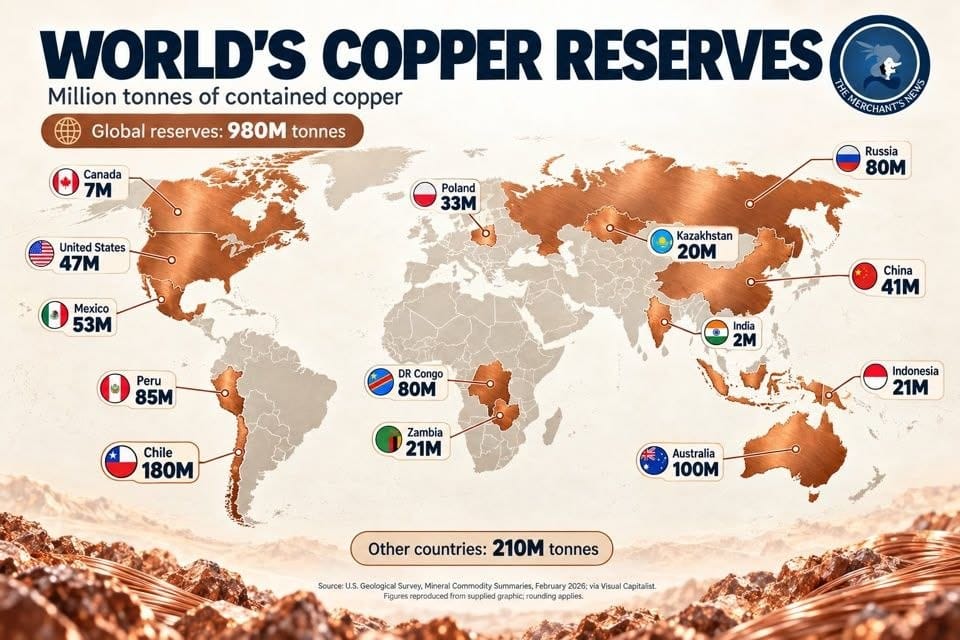
The world has mined more than 700 million tonnes of copper throughout history, and known reserves stand at 980 million tonnes . The constraint is not geological abundance. It is the economics of extraction and the pace of investment.
If copper becomes scarce enough and expensive enough, the incentive to substitute becomes overwhelming. That is not a prediction of failure. It is a prediction of adaptation.
What This Means for Investors
The copper shortage is real. The 2028 deficit projection is credible . The 17-year mine development timeline is a genuine bottleneck .
But investors should be cautious about treating a shortage narrative as a linear prediction of doom — or of guaranteed returns.
What to watch:
Substitution signals — Are manufacturers redesigning products to use less copper? Are aluminium or other materials gaining share in wiring and motors?
Recycling infrastructure — Is investment flowing into copper recovery and processing?
Mining investment — Is the $332 billion actually being deployed, or are capital constraints persisting?
Demand elasticity — Are higher prices reducing copper intensity in EVs, grid infrastructure, or construction?
The copper story is not a story about running out. It is a story about adaptation under constraint — the same story humanity has told for centuries.
The question is not whether copper will remain essential. It is whether we will continue to find ways to need less of it.
History says we will.
Sapient Consultants is a Hyderabad-based, SEBI-registered Investment Advisory Firm specialising in Shariah-compliant wealth management.Views mentioned are personal.
This article is for informational and educational purposes only. It does not constitute investment advice. Please consult a qualified financial advisor before making any investment decisions. Investments are subject to market risks.
Ready to Invest with Purpose?
Speak with an advisor. No obligation. Your first consultation is complimentary.