

There’s a lot wrong in Indian RE sector
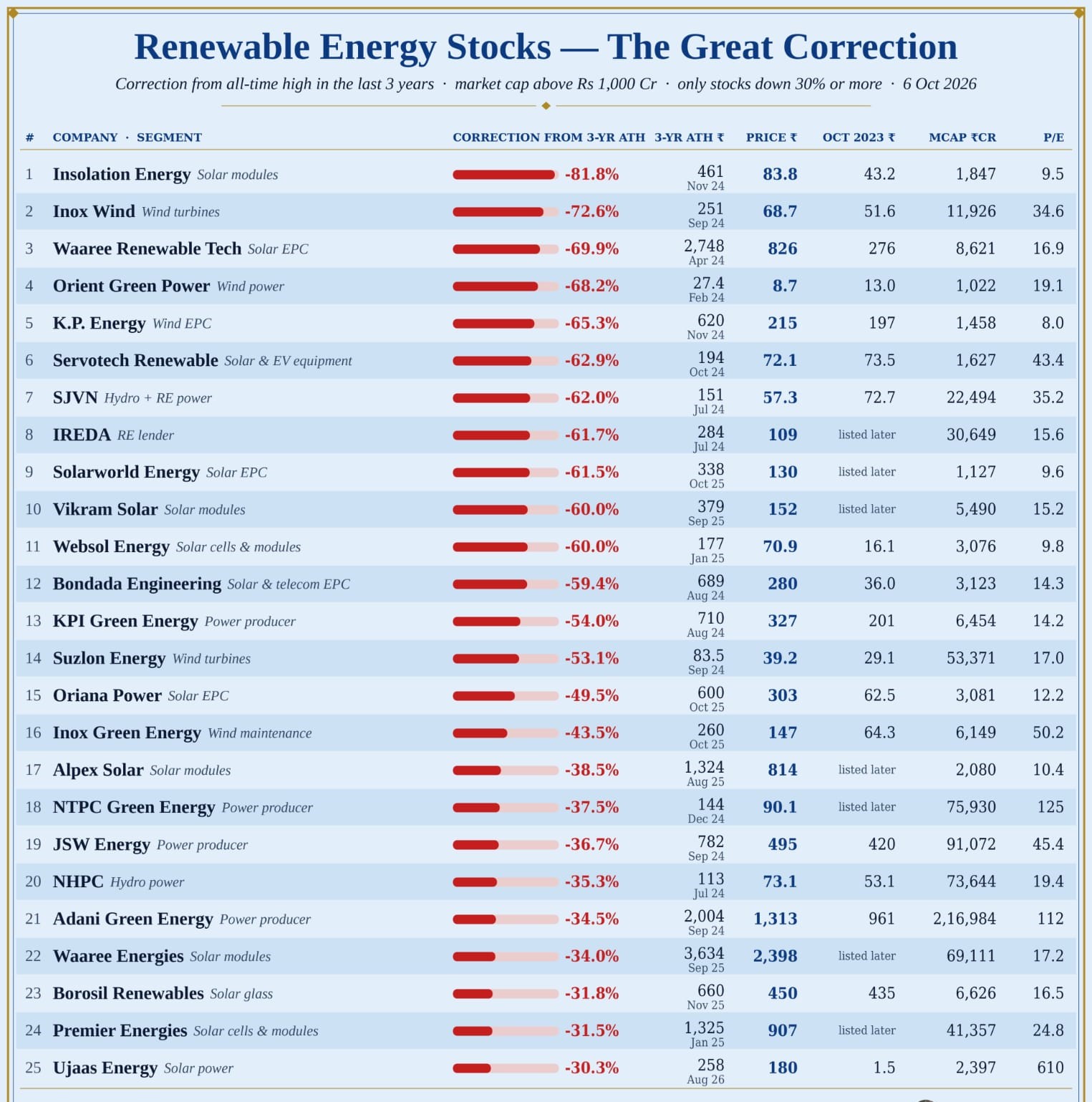
India's renewable energy sector has crossed 300 GW in non-fossil capacity — a historic milestone. But beneath the headlines, three structural bottlenecks threaten the trajectory: collapsing tender volumes, a manufacturing sector split between module glut and cell famine, and a grid that cannot evacuate what is being generated. This analysis examines the data behind the paradox, fact-checks the government's claims, and identifies the key indicators investors should watch in 2027.
India’s Renewable Energy Paradox: Record Growth, Weakening Foundations
By Sapient Consultants
India’s renewable energy sector is celebrating a historic milestone: 300 GW of non-fossil fuel capacity as of July 2026, crossing 60% of its 500 GW target for 2030 . Solar alone has surged from 2.8 GW in 2014 to 164.59 GW today, while wind has grown from 21 GW to 58.14 GW .
But beneath these headline numbers lies a more troubling story.
The Gap Between Ambition and Execution
The celebratory statistics mask a growing disconnect between capacity addition and the infrastructure needed to support it. Three structural bottlenecks threaten to undermine India’s clean energy trajectory: a collapsing project pipeline, a manufacturing ecosystem in crisis, and a grid that cannot keep pace.
Fact Check: The 300 GW Milestone Is Real — But Incomplete
The government’s claim of crossing 300 GW non-fossil capacity is accurate. However, this figure includes 57.24 GW of large hydro and 8.78 GW of nuclear — capacities that take decades to build and are not scaling at renewable rates . The truly dynamic growth is in solar and wind, and it is here that forward indicators are flashing warning signs.
The Pipeline Problem: Tenders Are Collapsing
What is being commissioned today reflects decisions made 12–24 months ago. Current tendering tells us what’s coming — and the numbers are alarming:
Year | Large-Scale Solar Tenders |
|---|---|
2024 | 79.5 GW |
2025 | 44 GW |
Q1 2026 | 5.7 GW |
Q2 2026 | 5.4 GW |
Wind tells a similar story: 1.35 GW added in Q1 FY26, an 18% decline from the same period last year. To meet its 2030 target, India needs roughly 10 GW of wind annually — but right-of-way issues and land disputes are stalling progress.
The implication: While installations break records today, the pipeline feeding tomorrow’s projects is thinning. The industry is living on borrowed momentum.
Manufacturing Crisis: Module Glut Meets Cell Famine
India’s solar manufacturing sector presents a paradox: too much module capacity, too little cell capacity.
The Numbers (Fact-Checked and Updated)
Metric | Figure | Source |
|---|---|---|
Cumulative module capacity (June 2026) | 261.7 GW | Mercom India |
Cumulative cell capacity (June 2026) | 36.6 GW | Mercom India |
ALMM-listed module capacity | 225.5 GW | MNRE |
ALMM-listed cell capacity (Oct 2026) | 37.39 GW | MNRE |
Module capacity utilization | 35–40% | Mercom India |
The mismatch is stark: India has 7 times more module capacity than cell capacity . Module manufacturers are struggling to keep production lines running because domestic cells are scarce and expensive.
The Cell Shortage Crisis
Raj Prabhu, CEO of Mercom Capital Group, summarized the problem bluntly: “Domestic cell shortages have become the biggest near-term challenge for India’s solar market… Many module manufacturers are struggling to maintain production because of limited domestic cell availability” .
The consequences are cascading:
Lead times for domestic cells stretch to 8 months
One-third of small and medium module manufacturers halted production (Reuters, June 2026)
ICRA warns of 20–25% cost increases for utility-scale solar projects
The irony: While module capacity threatens to outrun demand, cell shortages are raising costs and delaying projects.
The Grid Bottleneck: Abundant Generation, No Evacuation
Perhaps the most serious problem is one the government acknowledges but has struggled to solve: the grid cannot move the power being generated.
Curtailment: The Hidden Loss
Official government data confirms the scale of the problem. Solar curtailment during April–June 2026 totaled 8,133 GWh — equivalent to roughly 14% of actual solar generation during that quarter .
For developers caught in curtailment-prone zones, the impact is severe. CleanMax Solar expects a ₹170 crore loss from curtailment at one Rajasthan project. Over 60 GW of renewable capacity in Rajasthan awaits transmission connectivity.
Transmission: Falling Short of Targets
Year | Target (ckm) | Actual Added (ckm) |
|---|---|---|
2023–24 | ~25,000 | 14,200 |
2024–25 | ~25,000 | 8,800 |
2025–26 | 15,382 | 12,139 |
The target for 2026–27 is 16,554 ckm, with only 4,081 c km added as of July 2026 .
Right-of-way issues — including land acquisition disputes, forest clearances, and compensation disagreements — remain the primary bottleneck .
Smart Meters: Behind Schedule
Demand response and time-of-day tariffs could extract more value from the existing grid — but they require smart meters. Against a target of 20.33 crore meters by March 2028, only 5.73 crore had been installed as of June 2026 .
The Battery Storage Bet
The government is now betting on battery storage to absorb surplus generation. Renewables Secretary Santosh Kumar Sarangi stated that projects without battery storage are unlikely to find buyers, with 42 GW of planned capacity still without offtake contracts .
This is a significant policy shift — but battery storage economics remain challenging, and deployment timelines are uncertain.
What This Means for Investors
For investors in India’s renewable sector, the landscape is more nuanced than government press releases suggest:
Risks to watch:
Project pipeline depletion — tender volumes have collapsed, signaling a slowdown ahead
Manufacturing overcapacity — module utilization at 35–40% threatens industry profitability
Curtailment exposure — projects in Rajasthan, Gujarat face revenue losses from grid constraints
Transmission delays — 35+ GW of capacity faces curtailment risk in 2026–27
Opportunities:
Cell manufacturing — the genuine supply gap is in cells, not modules
Battery storage — policy tailwinds are strong
Transmission infrastructure — massive investment needed to close the gap
The Bottom Line
India’s renewable energy sector has achieved genuine, world-leading growth. The 300 GW milestone is real. Solar capacity has grown nearly 60-fold since 2014.
But the foundations are weakening. A collapsing tender pipeline, a manufacturing sector in crisis, and a grid that cannot evacuate power threaten to turn today’s records into tomorrow’s stranded assets.
The next phase of India’s energy transition will not be defined by how much capacity is built — but by whether the grid, supply chain, and demand infrastructure can keep pace.
Sapient Consultants is a Hyderabad-based, SEBI-registered Firm specialising in Shariah-compliant wealth management.
What to Watch: Key Indicators for 2027
Indicator | Current Status | Warning Sign |
|---|---|---|
Solar tenders | 5.4 GW (Q2 2026) | Below 10 GW quarterly |
Module utilization | 35–40% | Below 30% |
Cell capacity (ALMM) | 37.39 GW | Slower than module additions |
Transmission additions | 4,081 ckm (Apr–Jul 2026) | Below 16,554 ckm annual target |
Smart meters | 5.73 crore | Below 10 crore by end 2026 |
Curtailment | 8,133 GWh (Q1 FY26) | Above 10,000 GWh quarterly |
This article is for informational and educational purposes only. It does not constitute investment advice. Please consult a qualified financial advisor before making any investment decisions. Investments are subject to market risks.
Ready to Invest with Purpose?
Speak with an advisor. No obligation. Your first consultation is complimentary.